




Great store. Will be my favorite in the future. Sent quickly. All items are brand new sealed. And the prices are very nice. Separately, I want to thank Álex Guerra, who controlled my order from start to finish. In general, you are great!!
Thank you for the service. Absolutely top
Great comms. Very helpful and reliable all along
Order placed packaged well, dispatch and delivered promptly Would use again. Thank you
42/5000 the best team, both human and technical
-
 Comparativa VIARK: LIL2 vs VIARK SAT vs VIARK SAT Dual
Comparativa VIARK: LIL2 vs VIARK SAT vs VIARK SAT Dual VIARK LIL2, VIARK SAT y VIARK SAT Dual responden a perfiles diferentes dentro de la gama VIARK. LIL2 y VIARK SAT son receptores satélite; VIARK SAT [...]
-
 Receptor Satélite HD VIARK LIL2: características, funciones y para quién es
Descubre el receptor satélite más económico de VIARK, con el software del VIARK SAT pero más compacto y sencillo: VIARK LIL
-
 Cómo instalar y configurar un kit Cora Fermax: conexión, webserver y comprobaciones
Instalar un kit Cora de Fermax no consiste únicamente en fijar la placa exterior y conectar dos cables. Antes de alimentar el sistema hay que confirmar la tecnología DUOX Plus, revisar el cableado, identificar el número [...]
-
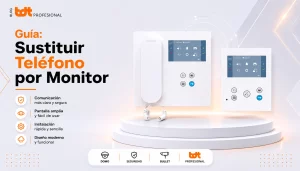 Guía: Cómo Sustituir Teléfono por Monitor Fermax Duox
Si tienes un teléfono interior Fermax y en el portal existe un videoportero compatible, es posible que puedas sustituir el terminal de audio por un monitor. El cambio permite ver la imagen de la placa de [...]
-
 NearKey para alquiler vacacional: cómo funciona la llave virtual y qué necesitas
Qué es una llave virtual para un alquiler vacacional Una llave virtual permite gestionar el acceso a una vivienda desde el teléfono móvil, sin entregar una llave física a cada huésped o trabajador. En un alquiler [...]
-
 Kabelio para ver canales ingleses en España: instalación, CAM y antena
Ver o distribuir canales ingleses con Kabelio PCMCIA CI+. Visualiza canales ingleses de forma sencilla.
-
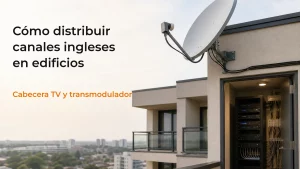 BBC y TV inglesa en edificios: cabecera, transmodulador y distribución
Cuándo necesitas una instalación colectiva de TV en inglés Una vivienda puede utilizar un receptor o un módulo CAM junto al televisor. En un hotel, comunidad, residencia, camping o negocio con muchas pantallas, colocar un receptor [...]
-
 How to watch BBC on Spanish TV: current options
Can you watch BBC channels in Spain? The answer depends on the exact channel, its current distribution rights and the reception method. Some UK services that were once available through open satellite reception are no longer [...]
CCTV Video Recorders
The CCTV video recorder is the key piece of any video surveillance installation.
It is in charge of gathering all the information captured by the cameras, transforming it and storing the information of the CCTV circuit. In addition, most of them offer functions such as:
- Sending images in real time via internet, to our tablet or cell phone, to be able to control what happens in situ in the CCTV installation.
- They allow sending event alerts by sms, email, or other notifications.
- They have alarm outputs, which can activate sirens or other deterrent devices.
Choosing a suitable video recorder is the first decision to make in a new installation to facilitate all other camera decisions. The resolution of the recorder should be equal to or higher than that of the cameras. We have IP recorders (NVR) and hybrid recorders (DVR) from top brands such as HikVision. We also have a brief section with CCTV Kits from brands such as Ajax. It is important to take into account the number of cameras we want to install when choosing a recorder with the right number of ports.
The cabled conection can be with coaxial or UTP cable. If we choose UTP, it will be necessary to use baluns to adapt the impedance and the video transmission by network cable works.
The recorders do not include a hard disk. You must select the size of the hard drive you want to install, the larger the capacity the more hours of video storage, and purchase it separately.
NVR Video Recorders IP
IP recorders are designed exclusively for IP cameras, allowing superior image quality with 4K resolutions. Ideal for those who require a high quality, all-IP installation, as these recorders do not accept any other non-IP technology, neither digital nor analog.
NVR recorders require a network infrastructure. That is, both the recorder and the cameras must be connected to the same internet network to communicate with each other. This is generally done through a local area network (LAN) using Ethernet UTP cables with RJ45 connectors, although WIFI recorders and cameras are also available for wireless connections. Video recorders usually have 4, 8, or 16 IP channels.
They can often include advanced features such as video analytics, motion detection and more customizable settings. Their initial cost is somewhat higher, but they compensate with high image quality, flexibility for camera placement, and low maintenance costs.
DVR Hybrid Video Recorders
A versatile and cost-effective solution to manage CCTV camera recordings with different technologies:
- Analogue, Digital and IP : 5 in 1 recorders
- Analogue and Digital : 4 in 1 recorders
5 in 1 Recorders
The 5-in-1 recorders use coaxial cable for their connections, which opens up the possibility of CCTV systems compatible with analogue cameras, digital cameras and IP cameras. In addition to the other ports on the recorder, there are RJ45 sockets for UTP cable connections to IP cameras. The great advantage is that they can support different digital protocols such as HDTVI, HDCVI, AHD and CVBS, making compatibility not a problem. We recommend selecting recorders with extra ports to allow for future expansion without major installation changes. And remember that IP ports are special, so check how many you have!
4 in 1 Recorders
The 4-in-1 recorders are almost the same as the 5-in-1 recorders, except that they do not have RJ45 ports. They support all 4 digital protocols and are compatible with analogue cameras.
The only difference is that they are not capable of integrating IP cameras.